Commercial · Saunas & steam rooms
Sauna fires have been widely reported across the leisure and hospitality sector, and insurers are increasingly treating suppression as a condition of cover rather than a nice-to-have. We offer two system types, so the choice depends on your building, not on what’s easiest for us to fit.
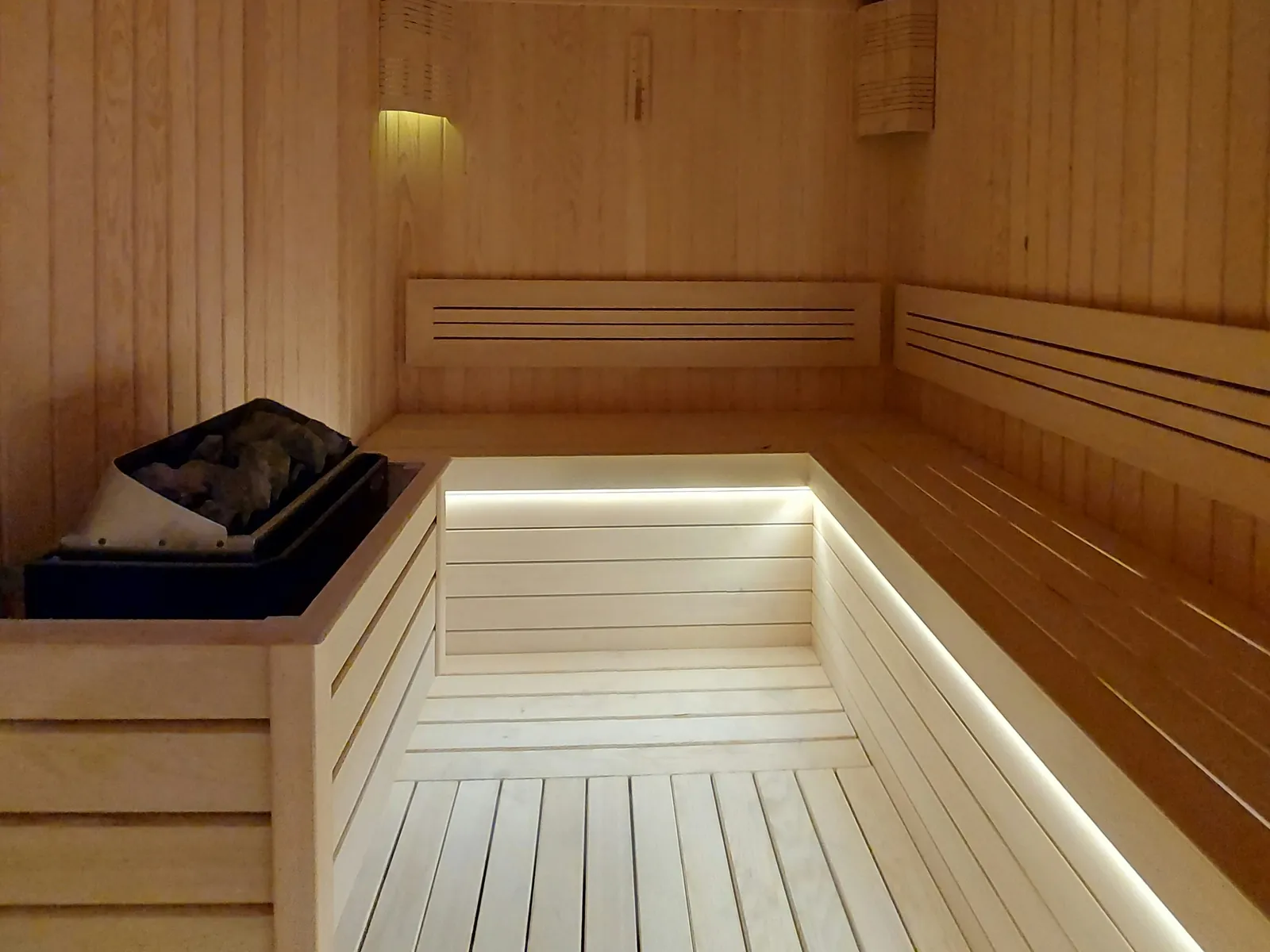
Illustrative image.
Two system types
Connects to your water mains and a dedicated electrical circuit, feeding nozzles from a compact wall-mounted pump. Needs a water and power connection at first fix, but takes up less long-term storage space — the right choice when running those services is straightforward.
No electrical supply and no water mains connection needed at all. Pre-charged cylinders feed heat-activated closed-head nozzles through a manifold, using the same frangible-bulb trigger as a traditional sprinkler head — only the nozzle nearest the fire activates, not the whole system. Built for late-stage retrofits, restricted-access builds, or any site where new services simply aren’t practical.
Both system types apply equally to steam rooms, not just dry saunas — the fire risk is different (electric steam generators and humidity-related electrical faults, rather than heaters, towels or oils), but the suppression approach and system choice work the same way.
Leisure and hospitality insurers have been responding to a run of reported sauna fires by pushing suppression from optional to expected. Getting ahead of that conversation is usually cheaper than reacting to a renewal quote.
Whichever system suits your site, the installation is designed, documented and certified the same way — so it stands up to both your insurer and, where relevant, your building warrant.
Choosing a system
Both systems are supplied through the SmartMist Systems network, so you get the same manufacturer-backed hardware and design standard whichever route suits your building — the difference is entirely about what your site can accommodate, not the quality of protection.
The standalone cylinder system earns its place on sites where running new electrical or water services simply isn’t practical — a listed building, a late-stage retrofit after the rest of the works are finished, or a building with restricted wall and floor penetrations. Because it needs no power connection and no mains water feed, it can go in with minimal disruption to a space that’s otherwise complete.
If your site already has straightforward access to power and water near the sauna, the mains-fed pump system is usually the more space-efficient and cost-effective route. If it doesn’t, the standalone system removes that problem entirely.
FAQ
It depends on access, not preference. If running a water and power connection to the sauna is straightforward, the mains-fed pump system is usually more space-efficient. If it isn’t — a listed building, a late-stage retrofit, restricted wall penetrations — the standalone cylinder system needs neither.
No — that’s the entire point of it. It runs on pre-charged cylinders with heat-activated nozzles, so there’s no pump, no power connection, and no water mains connection required.
Yes — both system types work the same way for steam rooms. Steam room risk tends to centre on the electric steam generator and humidity-related electrical faults rather than a dry heater, so the survey looks at slightly different things, but the suppression choice and installation approach are the same.
Both systems are designed, documented and certified to the same standard, which is exactly the kind of evidence insurers are increasingly asking for as sauna-related claims have risen across the leisure sector.
It’s checked as part of your annual service, the same as any other fire safety equipment — cylinder pressure and nozzle condition are confirmed each visit.
Yes — multiple sauna rooms can run from a single system through a shared manifold, which is often more efficient than fitting a separate system to each room.
Residential and domestic water mist systems, designed to the standard Scotland’s building standards cite.
Fitted and commissioned by qualified plumbers, backed by 19 years of frontline firefighting.
Design and consultancy for architects, builders and developers.
Tell us about the site and we’ll recommend the right system — mains-fed or standalone — with a clear, fixed quote and no pressure.